Showing posts with label Criterion Collection. Show all posts

Friday, December 14, 2012

Subconscious Film - Criterion Collection - Eclipse Series 24 - Dying At Grace (2003)

These essays are specifically for reading after ones personal viewing.


What strikes me first is the religion. As the head nurse makes her rounds, the undertone of her questions are a rhetorical utterance of how they should know God is with them. And that this – their pain and suffering – is "part of a bigger picture." None of them seem to believe her, which made me wonder, do you enter the hospital knowingly of this preaching? It’s called Grace Hospital, but nobody except one, who seems to be in a vegetable-like consciousness, is wanting or acceptingly a part of these religious feedings. This made me feel uncomfortable in her presence, and also juxtaposed my preconceived notions of how I thought the human mind worked close to death; instead of reaching out to God in their last hours, calling his name for the fear of the unknown, they threw Him away. But I'm able to understand – as most of their lives have been filled with pain, cancer not being the first spell – at times it seems or perhaps it is, that God has left, or was never there.

Having watched most of Allan King's Actuality Dramas, it helps to be an experienced viewer of vérité, to be able to break-into this new sense of viewing. Having the ability to openly interpret his films, one can then experience these new emotions, undistributed disturbed by a period of confused watching. 

There's a whole tone and voice any director/writer is trying to communicate with you. They're trying to immerse you in this new sense of feeling. Just like a novel. And like novels, we watch films one after another, experiencing different emotions and themes, which are personal to each creator. Sometimes (most of the time) when I read a new book, it takes time for me to escape the tone and voice of the last book I read, and pull myself into this new world, so fluidity may compliment my reading as I understand this new writer's sense of tone and voice. For films, I feel we plague our first viewings either by the last films we watched, or mostly by our own sense of personality, instead of watching with an open eye for the filmmaker's voice. Not that the films we love can't also be important to us personally, but that's not the only reason to love or enjoy a film. Now, it also depends on the filmmaker to have the ability to immerse his/her viewer's in his voice, but, I truly think a film should be a combined effort of both filmmaker and viewer. So even when you don't love a film, after viewing it with an openness of both the makers voice and personal undertones, you may be able to respect and enjoy the film for the vision and talent if it is genuine.

During my viewing, I developed a new filmic sense of emotion: I wanted to throw up from my sadness. I know it sounds terrible, and it was, but when dealing with death, I don't believe it could be any other way. I was then met with an odd aftertaste. When it was done and over, I felt....fine. I was able to lay down and sleep without the worry and anxiety which usually takes over my scattered mind before sleep. It was a sense of peace. Did King somehow instill in me a small sense of hope or acceptance within the walls of the Grace Hospital. That is the true gift of an artist: To instill a new sense of emotion and in turn, feel the relation of man through art. It is wholly inspiring to experience, and I hope to someday be on the side of its creation.

Always, 
The Seafairy

Wednesday, December 5, 2012

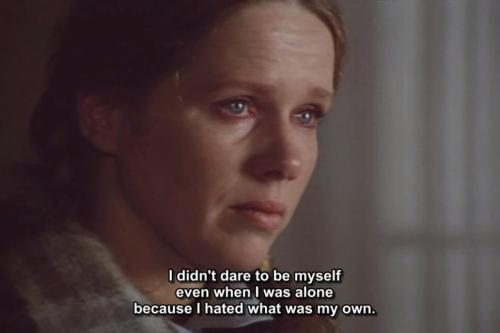
Subconscious Film - Criterion Collection - Autumn Sonata (1978)

These essays are specifically for reading after ones personal viewing.


Maybe it's odd I find it positively intriguing, but through the longing monologues and the subtle hard cuts into past experiences, I look at their teeth. They are as they should be. Away from the judgment of an insecure American society, which I was brought up in and live with today. They gleam with the natural tinge of age and proper preservation. They are human and are not afraid of the faults they show. Can a natural process be a fault? No, but I guess that's how we've come to recognize it, as an unhygienic disfigurement if it is not treated by perfection.

I make some social commentary about the differences of society as if they live a purer life, but this is also not true. The same amount of problems occur, but in a different way I am only just able to peek and begin to relate through the cultural differences as I continue my viewing. I can barely make out the dogma that surrounds it and only because I read the essay in my Criterion copy; which was read only before I started this paragraph. It's like reading a book you know is foreign and can feel the language barrier flowing past the top of your head. If only you could read it in its native tongue and feel the cultural microcosms.

But I can feel the beats and am moved by the emotion. Met also by a nice direction; crisp and wistful, into the light of Autumn.


Always, 
The Seafairy


Saturday, November 19, 2011

Subconscious Film - Criterion Collection - Onibaba (1964)

These essays are specifically for reading after ones personal viewing


        I fell in love with Kineto Shindo after his mesmerizingly-fantastique, Kuroneko. He instantly became my favorite Japanese director (specifically for the purpose of me not having one yet, despite having seen a fair share of Japanese films). I quickly gathered myself after watching Kureneko during the Annual 31 Days Of Horror Fest, and clicked the Wish List on each of the films that followed his career in Criterion. A friend and fellow writer of The Seafarers, reached his purchase before mine was even shipped; apparently, I wasn't the only one in on this fixation.

        Quite close are the themes in both films: the two main characters are a lonibaba mother, whose lost her son to the war, and her lonibaba daughter-in-law. The sexual repression is steaming from the moment we enter the film. The women sleep with their chests bare, due to the sweltering nights of Japan, that enslave their sexual fantasies and heighten the sense of deliriousness to those famished by small rashons of war. And we are constantly presented with fantastic shots of wheat, waving like a mother wanting back the son she's lost.

      As the younger gets involved with the returned samurai, the sweat and anything leading up to that sweat, is a metaphor into the mothers lost and wanting womb: beating clothes on logs and licking lips, licking chickens as a form of flirting. Not that I don't love the metaphors and cinematography - the young woman meeting the samurai through the wheat field and their outlines becoming only bodies, later used for the satisfaction of lust - but the tediousness does settle in a bit with the mothers progression of jealousy. And it's until she decides to do something where we find ourselves again, lost in the folklore of Shindonibaba.

        This mother has been enslaved by her lonibabaness, if the girl runs off with the samurai, she'll have nothing. After seeing the couple together for the first time late at night, she runs out to a large and thick tree and throws her arms around it - crying and wanting the lust of this tree to repress her thoughts of loneliness, like it does for the young couple. 

        I liked Onibaba. I think you can see the progression through Onibaba, to Kureneko and how much Shindo had grownibaba'd. But Onibaba leaves you satisfied during the strong hits of release upon the mask of torture. And when the mask is removed, all the sins are presented to us, not in the afterlife, but upon the earth that stirs up its hate. 


Always,
The Seafairy


Tuesday, August 23, 2011

Subconscious Film - Criterion Collection - Videodrome (1983)

These essays are specifically for reading after ones personal viewing.


        I've seen Videodrome before, but watching it again, I feel like I haven't been giving myself enough reason to like it. Although I can extract the surface content and love the practical effects, I wasn't digging myself in it personally. I feel like I should be able to protect the things I like; I thought of that while watching for a second time.


        The climbing acceptance of immorality and desensitization of people based around a box of sadomasochism in a metaphor form of addiction; the surface theme. Not hard to see, nor feel with the lash of a whip. I knew it was saying it in a "cool" way, but didn't feel like that was enough for me to like it to the extent I did; or, enough reason to protect the aspect of me liking it against those who would appose it's greatness. I kept my eyes on the skin of change.


        Emotional connectivity is found through the acceptance of death, or the contemplation there of. There is a slight silence by those who could feel Max's confidence in his "belief." His faith in the "new flesh." I wanted this confidence, and most importantly, I liked it. Is the new flesh an evolution in the body, or is it the progression of abstract thought, leading to death? Are those the same thing? When does Max's body coincide with his mind, and which does this evolution take course through; mind or body? Is Nicki God, or just the projection of Max's subconscious; or, a projection of what Videodrome wants Max to view as his subconscious?


         What is justice, in this world Cronenberg has placed us in? Max's killing is justified because of the sympathy you feel towards his character, his charm (because of our suspension of disbelief and the little we know of his character background) supersedes morality. The world Max lives in, or more the atmosphere Cronenberg has created, represents confinement; much like Terry Gilliam's Brazil which were both made in the 80's, two years apart from one another. Even the outside shots make me feel enclosed in a space that stretches lips and hands into whispers of masochism. A television. I don't know if I can analyze this movie. Are five question marks in a review good for a critique? Six. Questions are necessary for progression, so do people like and understand the use of questions in a critical analyzation. I didn't question mark that. I think if we learned anything from Terrence Malick, they most certainly are. So when I ask these questions, do I and the people I'm writing to learn around me, or is this just subconscious scat?


        When I was constantly questioning myself during Videodrome and caught the, acceptance of death, I was excited; proud even. I found something I could attach myself to. I then realized the answer of my fondness towards the film; I was connecting myself without the conscious knowledge of why, which is the purpose. I had found purpose and could then transform my purpose to intellect; which I know, must transform even further, and find the deeper meanings that cannot be accepted nor understood by my current mind. Death to Videodrome. Long live the new flesh...

Always,

--- The Seafairy